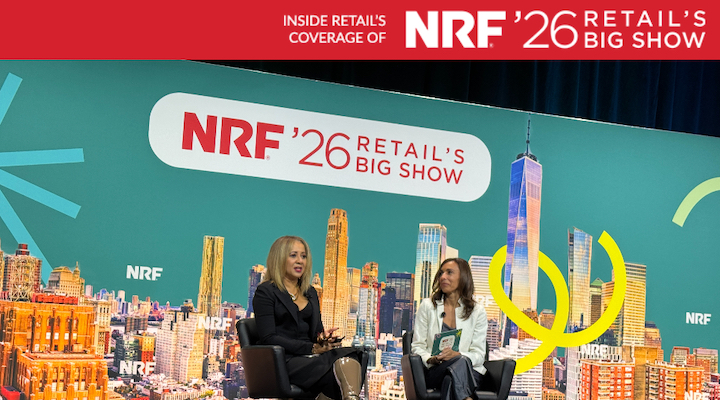
Last week, more than 40,000 people attended the National Retail Federation’s (NRF) annual conference to learn more about the latest trends in shopping and consumer behavior. One VIP these executives and industry professionals were eager to hear from was retail veteran Christiane Pendarvis, co-CEO of American haircare brand Pattern Beauty. Before joining her current company, Pendarvis held leadership roles at Savage x Fenty, Gap and American Eagle Outfitters. In a panel dubbed “Building and S
and Scaling: Winning in a Multi-channel World”, Pendarvis and Melissa Gonzalez, principal of MG2, a retail architecture and design firm, discussed the importance of setting up different content marketing and customer experience strategies across different sales channels. An approach to planning that is especially important for DTC-native brands, such as Pattern Beauty, which partner with multiple retailers across various selling platforms.
As Pendarvis told Gonzalez, “From nearly day one, we were multi-channel since we launched at Ulta about 10 days after we launched our DTC site. Since then, we’ve expanded with retailers like Target, Sephora, Nordstrom, Amazon, and Macy’s, so we really operate as a brand across a variety of channels and retail partners.”
“We’re always grounded in the consumer in that we put them at the center of everything that we do. From a multi-channel perspective, this looks like selecting the right partners that have access to that consumer base. Secondly, it means making sure we know what each retail partner brings to the table and making sure that we’re grounded in what each of them does. Then, we’ll tailor what we’re doing at Pattern Beauty to suit the specific needs of what is happening at each retail partner, while still being ourselves underneath our broader brand umbrella.”
Winning in a multi-channel world
One example of how Pattern Beauty tailors its approach to each retailer is seen in its partnership with its first major wholesale partner, Ulta Beauty.
“From day one, Ulta Beauty was our first and largest partner with over 1,400 locations. The brand operates hair salons at its locations, which, as a haircare brand, is incredibly enticing. Especially as a new-to-the-market brand where trial is a very important component of getting someone to convert, particularly textured hair consumers.”
Pendarvis explained that these consumers naturally hold a high degree of scepticism, questioning whether a product will work for their curly or coily hair type. Oftentimes, these consumers will not try a product unless they see it being effectively used on someone with a hair texture similar to their own.
“One of the things that we’ve done in partnership with Ulta is to do a salon takeover. That’s where our products are available at Ulta Beauty Salon. Consumers can come in, get a service experience with our product, and be converted in-store.
“That’s a unique example of how we can get the message out there and take advantage of the unique capability that only exists within Ulta. We’re very focused on how we show up in our retail partners, reflective of the consumer and of what that partner brings to the table.”
When discussing how to ensure the brand stays loyal to its principles while working with a retail partner, Pendarvis noted a difference in the approach the haircare brand had with Ulta Beauty.
For the big-box beauty retailer, before-and-after photos of product use are a common and often effective way to help consumers get a clear understanding of the product’s offering and to entice them to buy.
However, as Pendarvis explained, before-and-after photos run counter to Pattern Beauty’s ethos of embracing one’s natural hair texture and beauty, as well as the brand’s overall aesthetic.
Pendarvis recalled what the brand founder and fellow co-CEO, Tracee Ellis Ross, had told their retail partner.
“I understand that works for you, but part of our purpose and our narrative is to reframe things for this [textured hair] consumer, and that’s more important than the potential incremental revenue that we might get if we were doing a before-and-after.”
In this situation, while the haircare brand and retailer were mildly at odds over a merchandising approach, it was ultimately best for Pattern Beauty to stick to its guns.
“There’s a pitfall around allowing your retail partner too much control to dictate what you’re doing,” said Pendarvis. “It needs to be almost like a marriage of here’s what we’re uniquely bringing to the table, values that are most important to us, the identity and the aesthetic that we stand for, with what they [the retail partner] also bring to the table.
“You [as the brand executive] have got to figure out where those concentric circles overlap and what you need to execute. If you allow them too much control to tell you do this and that, you’ll end up looking like somebody else, and potentially everybody else that’s already in that retail channel.”
Pendarvis also emphasized the importance of using analytics research and customer feedback to create tailored channel approaches.
For instance, certain products may sell better at one retail partner’s stores, such as Sephora, than at others, like Nordstrom or Ulta Beauty.
It is essential to factor in sales analytics and the retailer’s overall sales approach when deciding which products to display.
Creating content for different consumers on various platforms
In addition to individualizing your brand’s merchandising approach for each retailer, it is important to apply the same level of detail and consideration to content planning.
For example, Pendarvis pointed out that while platforms like TikTok play a powerful role within the beauty industry today, it would hardly be effective to take a one-size-fits-all approach to selling products on different social media platforms.
“While TikTok is important for us, we’re not diverting all of our marketing budget to TikTok because our customers are also on Facebook. We then have to create the right type of content that works uniquely on Facebook, rather than what will work on TikTok, and make sure we’re partnering with the right people. So you have to really be holistic in your thinking.
“When you’re thinking about multigenerational consumers, you need to think about where and how you’re showing up and what images you will be using. You need to make sure that while you’re maintaining your message, you also allow that channel to shine [in its unique approach to selling].”
This also applies to the type of content creators and influencers the team works with across various platforms.
“We’ll partner with different content creators and influencers, specifically for TikTok, that looks very different from the more curated brand experience you’re going to see on our IG Reels. We’re very focused on this idea of tailoring, localising and maintaining your brand under its umbrella.”
Without taking this hyperspecialized approach to each retail partner and selling channel, Pendarvis warned that brands will miss opportunities to connect with customers on a clearer, more effective level.
Further reading: Day three at NRF: How retailers like Target are bracing themselves for 2026