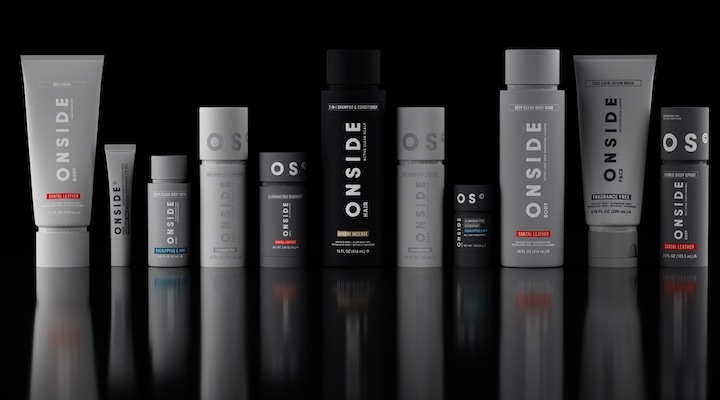
Despite launching in March of this year, men’s self-care and skincare brand Onside is already on track to generate $20 million in annual revenue and reach $100 million in revenue in its second year of business. Onside co-founder Bradley Churchill attributes the brand’s rapid rise to its hyper-focus on brand storytelling, strategic partnerships with celebrity athletes, such as NBA player Jayson Tatum and soccer player Jude Bellingham, and a calculated approach to physical and digital retail e
l expansion, including its exclusive launch in Target stores in May of this year.
Churchill, who is also the COO of multi-brand incubator and venture studio Non Normal Ventures, launched Onside after spotting a gap in the market for high-quality, luxury scented goods that catered to active men at an accessible price point.
He spoke with Inside Retail about the role of brand ambassadors at Onside and his long-term goals for the business.
Inside Retail: What was your background in retail before launching Onside?
Bradley Churchill: My background has always been in CPG and food and beverage.
I started my first business when I was 18, building a nutritional company in the UK. From there, I pivoted a lot, launching restaurants, Crave and Supreme Eats. My experience has been in the food and beverage space as well as the consumer goods space, with different products, such as supplements and now body wash. I also franchise a few gyms in Australia, called The Yard Gym.
Overall, my experience has been tied to the fitness, wellness and performance community.
IR: What inspired you to launch the men’s personal and skincare brand Onside?
BC: About four and a half years ago, I moved to America, and when I came here, my co-founder Ross MacKay and I put our heads together and looked at the personal care category and noticed a white space.
At the time, when you looked in mass retail spaces like Walmart or Target, there weren’t any brands built for the men who are active and who sweat. The only brand that was really embodying that message and that market was Art of Sport by Kobe Bryant.
They had been successful, so when we looked at the category, we thought about how we could position a brand in sport, but also elevate it, from the packaging design to the scents.
We wanted to bring higher-end scents like santal, inspired by Santal 33 from Le Labo, or eucalyptus mint, which are the scents of our hero SKUs, into mass retail more affordably.
Scent is the key that drives absolutely everything. It’s the scents and our approach to building a brand at an accessible price point that are the reason why we’re the number one brand on TikTok Shop in men’s grooming.
IR: How did you come up with the name for Onside?
BC: We wanted to have a name for the brand that was fairly common.
For us, it was layering this name with the inspiration of it coming from the world of sport, but also how it represents that if you’re “onside,” you are in a positive position of play in your life. This could refer to an athlete, a dad or an entrepreneur, who are all trying to play from a positive position.
There are different layers to the name: you can be “onside” in your own life, being consistent and determined in how you show up, or you can be “onside” with quality ingredients for the products you use for your skin.
When we filed for the trademark in the US, UK and Europe, I was surprised that this word, which gets said a million times a week across the world, hadn’t been taken.
So when you have millions of people every weekend at many sports events saying, “Get onside! Get onside!” they’re also screaming your name every weekend.
IR: What are the factors that separate your brand from other players in the space?
BC: A lot of brands will say they have high-quality products, but it’s questionable.
In terms of how we position our brand, we built our brand to be magnetic. Our athletic ambassadors are just the cherry on top of the icing.
The brand solves a problem for the active man. We built our ingredient list, such as our green tea extract and our avoidance of sulfates and parabens, to be high-performance and to create a sense of trust for the customer that Onside will help give them a boost of confidence in their daily lives.
When they use an Onside deodorant, they know that it won’t be wearing off in 30 minutes.
Onside isn’t just for the professional athlete who trains every day, twice a day. It’s for the everyday person who may cycle to work.
Everyone sweats, everyone moves and everyone walks. We want to show up for the man in this category with products that they can trust and that they actually feel work for them.
IR: It would be remiss of me not to mention Jude Bellingham, who really blew up in the US market in the post-World Cup fervor. How do athletic ambassadors play a role in the brand’s messaging?
BC: We’re not just a celebrity partnership brand.
Many brands just slap a label on a bottle and then have a famous individual endorse the brand, saying to shoppers, “Buy this.”
We really try to solve a problem through the quality of our ingredient story. Firstly, our innovation is built towards the man that moves, and then we reinforce our identity through our athletes. They essentially premiumize the brand and the product because they are [people] who men look up to and who men want to be.
We’re very meticulous in the athletes we try to bring on board to represent the brand.
Bellingham and Tatum are leading in their spaces and are unicorns in their sports. They only get to those positions through consistency, hard work and effort, which is everything we want the Onside man to embody.
While we feel like our ambassadors express that, we don’t rely on them to build sell-through.
Right now, a lot of people are realizing that with celebrity-driven brands, they end up spiking, then falling off a cliff. There’s no real magnetism to the people who you’re actually trying to connect with and sell to if you’re just trying to splash some body wash in a bottle and have someone endorse it.
IR: What are the long-term goals for the brand?
BC: Right now we’re working with Georgia Garinois-Melenikiotou [an Onside board member and former EVP of corporate marketing at The Estée Lauder Companies] and our leadership team about how we’re going to position the brand and gear it up for an exit.
In terms of timeline, we have a really aggressive 24-month model to reach the $100 million mark in revenue, at which point we would want to position the brand for an acquisition.
Essentially, we are looking to head down to $100 million annually, and we’re not going to look up till we reach that point.
Further reading: Tomorrow-Today Beauty’s Indianna Roehrich discusses building a brand with community