Apparel, accessories, bridal, home decor and furniture, beauty and fragrance, cookware – at this point, it may be easier to list the product categories Anthropologie doesn’t carry than the ones it does. It’s a move that was made strategically. Since the company opened its very first doors in the autumn of 1992 in Wayne, Pennsylvania, Anthropologie has been on a mission to create the ultimate in-store shopping experience. From decisively altering and adding upon its product assortment to
to curating the hottest brands on the market, including building several in-store lines, the brand has been putting the pedal to the metal to reach its goals.
Today Anthropologie has become a 360-degree lifestyle destination, with several top-notch crews developed to lead each growing product category, and over 200 stores around the world.
Over the past few years, under the direction of retail veterans Tricia Smith, Anthropologie’s global CEO, and Candan Erenguc, Anthropologie’s COO, the retailer has been especially intent at putting in its A-game to deliver a top-notch shopping experience.
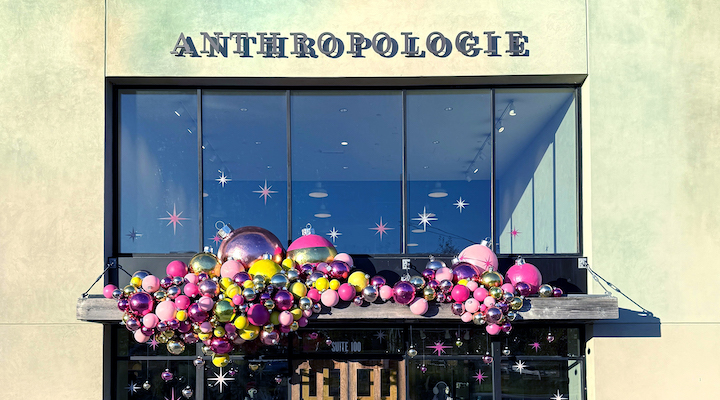
From producing striking artisanal-crafted window displays to organizing lively brand activations, such as the Pinterest X Anthropologie Holiday House, the brand is focusing on making its fans feel the true joy of retail, even if they don’t make a single purchase that day.
As Mindy Massey, Anthropologie’s global executive director of retail, told Inside Retail, “We really look at the stores as an extension of our communities, as they’re rooted with the customer and with building those authentic relationships. We try to provide a really inspirational environment. Who doesn’t love to walk into a store and see something beautiful that just leaves you awestruck?”
2025 was a very good year for Anthropologie
With a recalculated approach to bricks-and-mortar expansion, a sharper-than-ever eye on digital innovation and a surgical precision in owned brand curation, Anthropologie’s numbers have been as shiny as its holiday merchandising offerings.
Erenguc reported that the brand achieved a 6 percent increase in retail segment comparable sales in the second quarter of fiscal year 2026, marking over four consecutive years of positive quarterly comps.
Growth was primarily driven by balanced strength across both digital and physical store channels, fueled by increased traffic and transactions. She also noted that all major product categories – apparel, shoes, accessories and home – showed positive regular price and total sales comps in Q2 FY26. Notably, apparel growth was bolstered by the continued momentum of owned brands like Maeve, Daily Practice, Celandine, Pilcro and the company’s recent addition, Lyrebird, a high-end line of intimates and sleepwear goods.
Within the next few years, Erenguc noted, the brand has plans to strategically grow its physical retail footprint with new store openings, expanding the Anthropologie fleet from 243 to 270 locations globally.
Using data to work smarter, not harder
Erenguc noted that Anthropologie’s growth has stemmed from a restructured approach to real estate, along with an overall optimization of omnichannel operations.
“We’ve come to recognize and appreciate that our customers are omnichannel customers. They want to shop online and they want to shop in stores, and so we’ve aligned our store strategy and our DTC strategy so that they’re truly working in tandem.”
She added, “We’re using DTC data along with local market insights, and, of course, listening to our customers and our teams in the market to figure out not just where to put stores, but also how big a store should be, what categories it should carry and which collections and styles. As we open new stores, you’ll notice they vary a lot more in size than they used to, because we’re customizing them for the market they’re in.”
For example, in some markets, a store can cover about 5000 square feet, whereas in another neighborhood, it can go up to 15,000 square feet.
Additionally, the team has invested in an allocation segment that makes sure it localizes its assortments in a way that speaks to customers shopping at a local store, such as figuring out the ratio balance of boots to sneakers depending on the store’s location.
“It’s a much more complex way to run the business, but it’s how we make sure that we’re giving customers what they want.”
Leaning into the whimsy of shopping
Even before a customer steps into a store, Anthropologie wants to make sure they know this isn’t like any other shop in the neighborhood.
“We really love to employ artists in our stores’ designs. We’ve protected the beauty of visual merchandising in our store, where other brands have kind of moved away from that. That [approach to visuals] has been something that has really helped us appeal to a generational group of customers,” Massey said.
Aside from unique, eye-catching window displays, another way the brand taps into the whimsical side of shopping is with the launch of trending, somewhat niche, SKUs.
“Our merchandising team is the best of the best, and they know what’s going to be cool before it’s cool, and they are on it,” Erenguc said.
She highlighted an unexpected trend that took root in late summer 2024, which has since taken the food and fashion industry by storm, tinned fish. More specifically, sardines packed in beautifully designed tins from Portugal and Spain.
“Who would have thought, like, tinned fish was going to be this whole thing and that we’d be wearing dresses with, like, fish?,” Erenguc mused. “I never in a million years would have thought that but, of course, I’m not a merchant. But they [our merchandising team] knew and they got right on it. So if you want a dress, bag or earrings with sardines on it, you’ve got it.”
From ideation to execution, the COO noted that it takes about eight weeks for a product to reach the consumer.
Both Erenguc and Massey praised the team’s ability not only to hop onto a trend with speed and precision, but continually to supply the playful and joyful products the customers love to see.
“We’re so good at finding something that really makes you happy and joyful. Items that you didn’t even know you needed, but can’t stop thinking about it and end up really wanting to have. I think it’s what we’re best at,” Massey said.
“We’re also uniquely good at balancing trends with customer favorites and offering trends in a really democratic way so that customers can adopt those trends in whatever ways work best for them,” Erenguc added.
The COO pointed to the industry’s current dog obsession and herself and her daughter as a case study.
Where her daughter is interested in wearing a sweater sporting a cute doggy motif, she leaned into the trend with one of Anthropologie’s bestsellers, the Icon Table Lamp, dog edition. The lamp, which retails for $298, comes in a number of options for dog owners, ranging from a Cavalier King Charles Spaniel to a chow chow to a yorkie.
“That speaks to the generational adaptation of trends and how our customers get to choose how they participate in them,” Erenguc said.
Keeping things fresh for every consumer generation
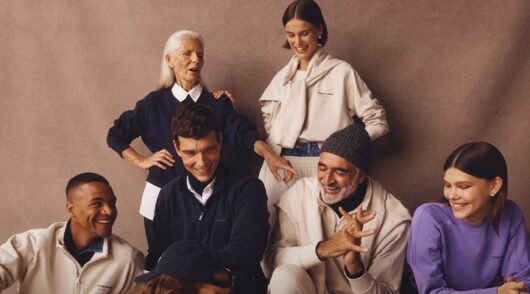
Speaking of generations of shoppers, Anthropologie has managed to do what few lifestyle retailers before them have, create a curated range of products in one setting that can appeal to multiple generations of shoppers.
From high-end furniture pieces to decorate your first home to occasion attire for special events like a wedding (from guest to bridesmaid to bride) to an expertly chosen array of beauty products, Anthropologie has been able to fulfil basically any lifestyle shopping need its customers may have.
Erenguc, who had previously worked with retailers like Away and Lululemon, commented, “This is the first brand where I’ve worked where my mom, my sisters, my daughter and my nieces all want me to take them shopping, and I am very, very proud of that.”
She also noted that the team is always centered on leaning into what customers are asking for, which is easily seen in the company’s arsenal of owned brands which, as of July 2025, made up a record 71 per cent of the business.
Massey commented, “It’s exciting to really have such a robust own-brand strategy, because you’re not only creating omnichannel growth, you’re establishing a brand of brands. Our strategy allows us to have product that is uniquely ours, while also having vertical integration to support emerging trends or new brands.”
One particular in-house brand that Anthropologie has been pouring its efforts into as of late is Maeve.
Even though the brand was launched in 2005, it has recently been gaining traction with Anthropologie’s audience, largely Gen Z and younger Millennial shoppers. Maeve became the company’s most-searched brand on its website, garnering 3 million searches and driving over 10 million TikTok views.
In August, Anthropologie announced the debut of Maeve as a stand-alone brand and this October marked the opening of its first bricks-and-mortar store, in Raleigh, North Carolina. There is a second Maeve store opening scheduled to take place this January in Buckhead Village, a popular shopping destination in Atlanta, Georgia.
“Though we’re going to keep it a little bit of a surprise about which stores are next, there are more to come, so stay tuned,” Erenguc said.
The key ingredient in Anthropologie’s success
“What has made our team strong is, first of all, really strong leadership from our CEO, Tricia Smith. Part of the key to the way she leads us is that she has defined a North Star for us, on which we have maintained our focus year over year.”
Massey, who joined the Anthropologie team as a district manager in 1999, noted, “We’re a delicious layer cake. The first layer was great and we’re continuing to build upon it by refining our strategies without changing the recipe.”
Erenduc and Massey both noted that Smith’s strong leadership capabilities lie in the way that she allows each team to lead with its area of expertise, but makes sure they are able to come together in one cohesive retail ‘cake’.
Adding upon the rather yummy analogy to describe the team’s overarching management philosophy, Massey stated, “It’s an environment where everyone’s ingredients are important and everybody understands the end goal. We all make sure that we’re aligned with the ethos [of the company], or the flavor profile, if you will.”
“We’re really building on top of a strategy that is based on following our North Star for customer and product growth,” Erenguc concluded.
Further reading: Anthropologie teams with Metropolitan Museum of Art in homewares range