
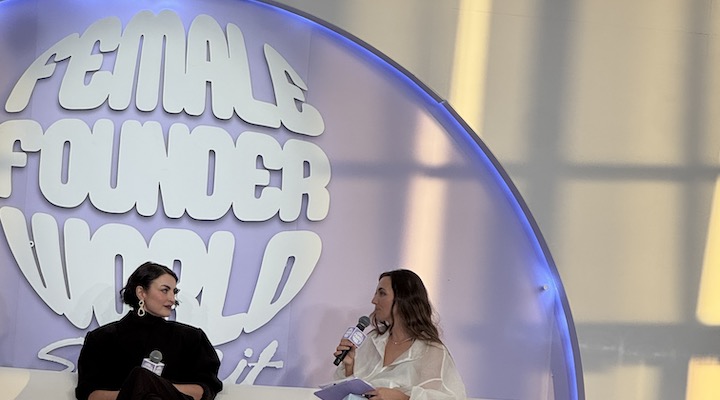
For the fourth year in a row, the retail industry’s leading female founders, business executives and aspiring entrepreneurs gathered in New York City for the annual Female Founder World Summit. This year’s event took place at Pier 60, a spacious waterfront venue overlooking the Hudson River. Executives from leading brands including Arrae, Etoile and Dieux shared their insights into building and sustaining multi-million-dollar brands. Discussions covered everything from embracing what Ceremon
eremonia founder Babba C. Rivera described as a brand’s “unfair advantages” to unconventional, community-focused marketing, championed by Good Girl Snacks co-founder Leah Marcus.
Two themes emerged from the discussions: the importance of developing a distinct brand story through marketing campaigns and carefully curated product launches, and the value of setting industry trends rather than simply following them.
As Charlotte Palermino, co-founder and chief brand officer of skincare brand Dieux, told the audience, “Part of being a founder is also trying to shape where the industry is going.”
For Palermino, staying ahead of the competition means studying industry reports to anticipate the next big beauty ingredient, while closely monitoring consumer feedback and shopping sentiment.
Attention hackers: Pioneering a new digital marketing blueprint
During a panel moderated by Alexis Barber, content strategist and founder of media platform Too Smart For This, Good Girl Snacks co-founder Leah Marcus and Barefaced founder Jordan Harper shared the strategies behind their brands’ marketing campaigns.
Marcus emphasized the value of posting frequently and documenting both the highs and lows of building a business. She also highlighted the impact of unconventional marketing stunts.
“We’ve [my co-founder Yasaman Bakhier and I] been building in public since day zero of having this company, and we still are doing that now,” Marcus said. “That means posting vlogs every day and showing all of the negative and positive stuff that’s happening to us.”
She pointed to a viral video featuring the pair carrying an oversized Hot Girl Pickle pouch through New York.
“Recently, we had a video of us with a giant grab-and-go Hot Girl Pickle pouch go viral in New York, and I think these moments that we’re creating are the ones making people remember who we are. So when they go into the store and they see our product, they will buy it. So guys, post our content; it works.”
The stunt formed part of a campaign dubbed “Bigger isn’t always better”, which Marcus and Bakhier deliberately designed to provoke a reaction.
“With the ‘Bigger isn’t always better’ campaign, it was literally Yas, my best friend and co-founder, sitting there, talking about how size doesn’t matter, bigger isn’t always better, and we knew that it was going to create a reaction,” Marcus recalled. “People were going to send that content to each other and repost it because it was literally ridiculous.”
By consistently sharing organic, culturally relevant content, Good Girl Snacks has built an identity that appeals not only to snack enthusiasts but also to consumers drawn to brands with a distinctive personality and sense of humor.
Harper, meanwhile, advocated a more straightforward approach to brand storytelling.
Barefaced is a results-driven, medical-grade skincare brand focused on simplifying daily beauty routines. For Harper, frequent product launches and flashy marketing campaigns run counter to that philosophy.
Instead, the brand launched “One Less Thing”, a campaign promoting the effectiveness of its existing products rather than introducing new ones.
“We are in a drop-heavy sellout culture which will sometimes equate to some instant sales,” Harper said. “However, a lot of these brands are dropping product with no sustained strategy. We [Barefaced] are really focused on the lifetime value of our customer. While we launched nothing with the ‘One Less Thing’ campaign, we still had a 20 per cent increase in traffic and sales to our site.”
The campaign demonstrated how Barefaced could drive traffic and sales without investing in another product launch, while reinforcing its message of simpler skincare routines.
“While launching is fun because there’s hype around it, you can easily dilute your brand if you are only focusing on launch after launch after launch,” Harper said. “We are profitable because we focus on the lifetime value of our customer, versus quick cash grabs, and being sustainable with our messaging.”
How Mph Beauty built a successful influencer marketing strategy through authenticity, not volume
Kira Mackenzie Jackson, chief marketing officer of Mph Beauty, warned against taking a “spray and pray” approach to influencer marketing.
Speaking during a session dedicated to influencer marketing, Jackson said brands should first analyze their customer data to establish exactly who they are trying to reach.
“I know everybody says this, but if you don’t understand your ideal customer profiles (ICPs), and who your ‘it girls’ are, then any influencer marketing you’re doing, be it gifting or any other type of community building, is frankly going to be ‘spray and pray’, throwing something at a wall and hoping that it sticks.”
Rather than relying on their instincts or assuming their customers share their own preferences, founders should use data to build detailed consumer profiles.
“Don’t allow yourself to project who you want your customers to be,” Jackson warned.
She recommended giving these profiles names and personalities, making them easier for marketing teams to visualize and target.
“So for us, our core consumer is ‘Camille’. We talk about Camille all the time internally as a marketing team, asking questions like, ‘Does this make sense for Camille?’ or ‘Would Camille be excited about it?’”
With a clearly defined customer in mind, brands can identify influencers who are more likely to resonate with their audience. But selecting the right creators is only the beginning. Jackson stressed that building genuine relationships matters more than producing large volumes of content.
“Success is not volume of influencers; it’s the relationship that you have with the influencers that are in your community,” she said.
Follower counts alone are no guarantee of success. If an influencer’s content fails to engage the target audience, the partnership is unlikely to deliver results.
Jackson advised brands struggling with ineffective influencer partnerships to start again with a smaller, more carefully selected group.
“Scrap the whole list and start with five people,” she said. “Literally just take out the brass tacks and determine who the five people are who are going to move the needle and be your brand’s evangelists, and build from there.”
Those five advocates can then introduce the brand to their own networks, creating a chain of recommendations that expands its reach organically rather than through overt promotion.
Open for business: Marketing edition
During a panel moderated by brand strategist and influencer Gigi Robinson, Ceremonia founder Babba Rivera and Arrae founder Siff Haider discussed how their personal profiles can help smaller brands compete with established players with far bigger marketing budgets.
Haider founded Arrae after struggling with her own health and recognizing that other consumers faced similar challenges.
“We have targeted solutions for your most unsexy problems, but we actually make it sexy,” she said. “Essentially, we got our start because I had been struggling with my health for a really long time, and back in the early 2010s, wellness was not cool. In fact, it was very granola and weird, and just out of frustration with my own health, I found myself in the business of holistic wellness.”
Arrae initially launched two products: Bloat, a fast-acting digestive enzyme, and Calm, a stress-relief and relaxation supplement.
Haider used emotional storytelling to build a personal connection with consumers, supported by The Dream Bigger podcast, which she launched two years before founding Arrae. Within five years, the brand had surpassed $100 million in annual revenue.
“When it comes to personal branding, I always say that finding the avenue that works best for you is the way to go,” Haider said. “The truth is that I started my podcast two years before Arrae, just because I am an inherently curious person, and I really wanted to share what I learned with people. The podcast has really helped Arrae in so many different ways.”
The podcast helped Haider forge relationships with other founders and brands, opening the door to future partnerships. It also connected her with influential tastemakers who went on to try and organically promote Arrae’s products.
“Beyond all that, it allowed me to connect with our consumer base in a way that was really valuable,” she said. “One thing that indie brands have as a superpower to larger conglomerates is that it was started by real people. The fact that our consumer gets to know that I’m the founder, and I can build this one-to-one connection with them, is my superpower. I may not have the budget that Unilever has, but I have a powerful community, which I’ve been able to build because of these media platforms that are available to us at our fingertips.”
Rivera has similarly leveraged her personal profile to create opportunities for Ceremonia, including a partnership with technology company SharkNinja.
SharkNinja initially approached Rivera to promote a new hair-straightening tool designed to cause less heat damage than conventional products. Rather than agreeing to a standalone paid campaign, she proposed a masterclass demonstrating how the tool could be used alongside Ceremonia’s new Guava Gloss Drops.
The masterclass and accompanying content proved so successful that Ceremonia sold out of the product at Sephora within five days of its launch.
“I have found that as a founder with a platform and a personal brand, I’ve been able to broker really interesting partnerships for my brand because I can put myself as part of the deal package,” Rivera said. “And as a result, even if my brand is much smaller or doesn’t have the same budget as the brand we’re trying to partner with, we’re able to make up for that with my personal brand as a lever.”
Further reading: NRF’26 Apac: How retailers stay resilient, seize opportunities amid challenges